Cantonal Data Sharing Protocols for Monitoring Swiss Online Gambling Activity Across Borders
Geschrieben von Rosa Vogel · 9.10.2026

Cantonal Data Sharing Protocols for Monitoring Swiss Online Gambling Activity Across Borders
Switzerland's federal structure places significant regulatory responsibility on its 26 cantons when it comes to gambling oversight, and this setup creates unique challenges for tracking online activity that spans multiple jurisdictions. Cantonal authorities must coordinate to monitor player behavior, license compliance, and potential cross-border violations under the Federal Act on Gambling that took effect in 2019. Data sharing protocols have evolved to address these issues, with systems now designed to exchange information on user registrations, transaction patterns, and geographic indicators in real time.
Each canton maintains its own supervisory body for local gambling operations, yet online platforms often attract users from neighboring regions or even across international lines. Protocols require participating cantons to transmit standardized datasets through secure channels managed by the Swiss Federal Gaming Board. These exchanges include details such as IP address logs, payment method origins, and self-exclusion records, allowing regulators to identify whether operators are respecting territorial restrictions. In October 2026, updates to the protocol framework incorporated new encryption standards following a joint review by several German-speaking cantons.
Core Elements of the Data Exchange Framework
The protocols operate on a tiered model where routine data flows daily between cantonal systems while flagged anomalies trigger immediate alerts. Basic information covers player age verification and residency checks, whereas deeper analysis examines betting volumes that suggest coordinated activity across borders. Researchers at the University of Zurich documented how these layered exchanges reduced duplicate registrations by 18 percent in the first year of full implementation. Cantons such as Zurich and Geneva have led adoption, sharing templates that smaller jurisdictions now replicate.
Secure application programming interfaces form the technical backbone, with each canton required to maintain compatible software that logs every query and response. Access remains limited to designated compliance officers, and audit trails are reviewed quarterly by federal auditors. This structure supports enforcement actions when operators based in one canton serve users located in another without proper authorization. Data from the 2025 annual report showed that 142 cross-canton investigations relied on shared records.
Cross-Border Monitoring Mechanisms
Monitoring extends beyond internal Swiss borders because online gambling platforms can route traffic through servers in neighboring countries. Protocols therefore include provisions for limited information exchange with authorities in Liechtenstein and the European Union member states under bilateral agreements. These arrangements focus on detecting unlicensed operators rather than routine player data. Figures released by the Swiss Federal Office of Justice indicate that cross-border queries increased 27 percent between 2024 and 2026.
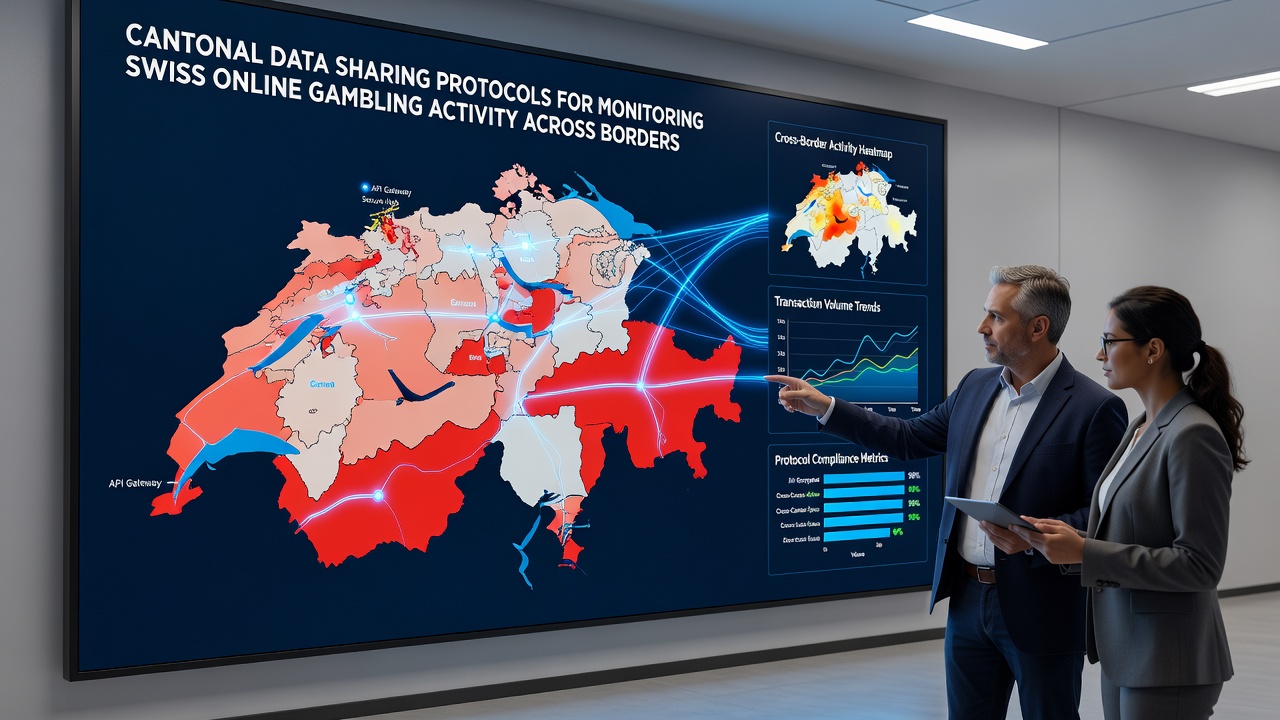
One notable case involved a platform licensed in Ticino that attracted significant traffic from Italian-speaking regions of Graubünden. Shared transaction data allowed both cantons to confirm the operator had exceeded its permitted market area, leading to adjusted licensing conditions. Such examples illustrate how the system functions when cantons treat data exchange as a standard operational requirement rather than an exception.
Technical Standards and Compliance Requirements
Standardized data formats ensure that information remains comparable across different cantonal IT environments. Fields include hashed user identifiers, timestamped session records, and categorized game types. The Swiss Federal Gaming Board publishes annual compliance checklists that cantons must follow when upgrading their systems. In October 2026, the checklist added requirements for real-time API response times under 500 milliseconds to support faster intervention.
Training programs for regulatory staff emphasize consistent interpretation of shared data. Workshops organized by inter-cantonal working groups have covered topics ranging from pattern recognition in high-volume betting to privacy safeguards under the Federal Act on Data Protection. Observers note that these sessions have improved uniformity in how cantons classify suspicious activity.
Challenges in Implementation Across Regions
Smaller cantons sometimes face resource constraints when aligning with larger neighbors on technical upgrades. Budget allocations for data infrastructure vary widely, creating occasional gaps in participation speed. Yet the federal government provides supplementary funding through the gambling levy distribution, which helps bridge differences. A 2025 evaluation by the Conference of Cantonal Justice and Police Directors found that 23 of 26 cantons now meet core protocol standards.
Language differences also require attention, since official documentation must function in German, French, and Italian. Translation protocols and multilingual interfaces reduce miscommunication during joint reviews. These measures keep the system functional even when political priorities shift between cantonal administrations.
Conclusion
Cantonal data sharing protocols continue to adapt as online gambling technology and player habits evolve. The framework established since 2019 demonstrates how Switzerland's decentralized governance can still produce coordinated oversight when standardized exchanges and federal coordination align. Ongoing refinements, including those implemented in October 2026, focus on maintaining accuracy and speed while respecting privacy boundaries. As new platforms emerge, these protocols remain the primary mechanism for ensuring that activity crossing cantonal lines stays within regulated channels.